

Metamaterials Market to Reach US$10.0 Billion by 2033, Expanding at a CAGR of 25.9% from 2026–2033
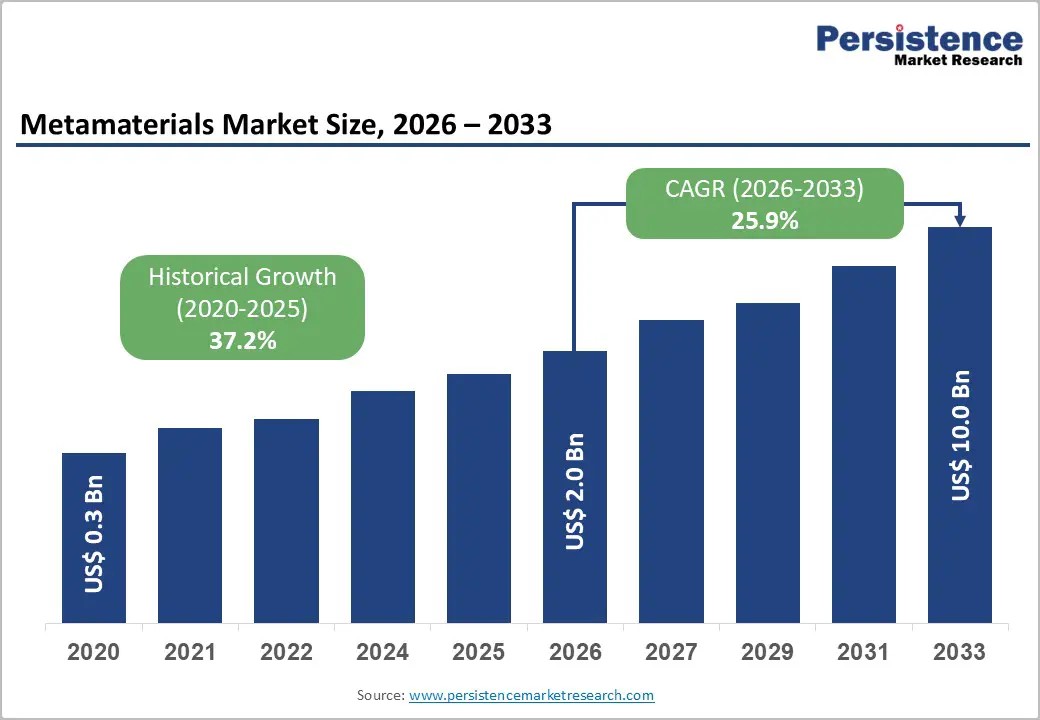
The metamaterials market to grow from US$ 2.0 Bn in 2026 to US$ 10.0 Bn by 2033 at 25.9% CAGR, driven by advances in aerospace, telecom, and defense
BRENTFORD, ENGLAND, UNITED KINGDOM, June 15, 2026 /EINPresswire.com/ -- The global metamaterials market is projected to grow from US$2.0 billion in 2026 to US$10.0 billion by 2033, registering a robust CAGR of 25.9%. Growth is driven by rising adoption of 5G and 6G networks, increasing defense modernization programs, advancements in nanotechnology, and the integration of AI-powered metasurfaces. Metamaterials are gaining traction across telecommunications, aerospace, defense, healthcare, consumer electronics, and automotive industries due to their ability to manipulate electromagnetic waves and enable device miniaturization.
The aerospace and defense sector is the leading end-user segment, accounting for nearly 40% of market demand, while passive metamaterials dominate the technology segment with around 72% share due to their reliability and cost-effectiveness. North America leads the global market with approximately 40% share, supported by strong defense R&D and advanced technology adoption, whereas Asia Pacific is expected to be the fastest-growing region due to rapid 5G deployment, expanding semiconductor manufacturing, and growing investments in next-generation communication technologies.
𝐆𝐞𝐭 𝐚 𝐒𝐚𝐦𝐩𝐥𝐞 𝐏𝐃𝐅 𝐁𝐫𝐨𝐜𝐡𝐮𝐫𝐞 𝐨𝐟 𝐭𝐡𝐞 𝐑𝐞𝐩𝐨𝐫𝐭: https://www.persistencemarketresearch.com/samples/14584
Market Segmentation
The metamaterials market can be segmented based on technology type, end-user industry, and application. By technology type, the market is divided into passive metamaterials and active/tunable metamaterials. Passive metamaterials currently hold the largest share because of their established performance characteristics, lower production costs, and extensive deployment in telecommunications, aerospace, and consumer electronics. These materials offer reliable electromagnetic manipulation without requiring external control systems, making them highly suitable for commercial applications.
Active or tunable metamaterials represent the fastest-growing segment due to their ability to dynamically adjust electromagnetic properties in real time. These advanced materials leverage technologies such as MEMS, liquid crystals, and phase-change materials to enable adaptive beam steering, interference mitigation, and programmable wave control. Their adoption is increasing rapidly in 6G communications, autonomous vehicles, satellite communications, and military systems.
Based on end-user industry, the market includes aerospace and defense, telecommunications, healthcare, automotive, consumer electronics, industrial manufacturing, and others. Aerospace and defense dominate the market due to growing requirements for advanced radar systems, stealth technologies, electronic warfare capabilities, and intelligent sensing platforms. Telecommunications is expected to witness the fastest growth as network operators increasingly deploy reconfigurable intelligent surfaces and advanced antenna systems to support 5G Advanced and emerging 6G infrastructures.
Applications of metamaterials are expanding across imaging systems, satellite communication terminals, radar systems, sensors, antennas, medical diagnostics, wireless communication devices, and energy-efficient buildings. Their ability to manipulate electromagnetic waves with exceptional precision continues to create new opportunities across diverse industrial sectors.
𝐃𝐨 𝐘𝐨𝐮 𝐇𝐚𝐯𝐞 𝐀𝐧𝐲 𝐐𝐮𝐞𝐫𝐲 𝐎𝐫 𝐒𝐩𝐞𝐜𝐢𝐟𝐢𝐜 𝐑𝐞𝐪𝐮𝐢𝐫𝐞𝐦𝐞𝐧𝐭? 𝐑𝐞𝐪𝐮𝐞𝐬𝐭 𝐂𝐮𝐬𝐭𝐨𝐦𝐢𝐳𝐚𝐭𝐢𝐨𝐧 𝐨𝐟 𝐑𝐞𝐩𝐨𝐫𝐭: https://www.persistencemarketresearch.com/request-customization/14584
Market Drivers
The metamaterials market is primarily driven by the rapid expansion of 5G and emerging 6G networks, which require advanced technologies for improved signal transmission, beam steering, and wave control. Rising global defense investments are also boosting demand for metamaterial-based radar, stealth, and sensing systems. Additionally, advancements in nanotechnology and photonics are enabling more efficient and scalable production, supporting wider commercial adoption.
Market Restraints
High manufacturing complexity and production costs remain major challenges for the metamaterials market. The need for precise nanostructures increases fabrication difficulty and limits large-scale deployment. Furthermore, the lack of standardized testing protocols and concerns regarding durability and performance consistency restrict adoption across several industries.
Market Opportunities
Growing adoption of autonomous vehicles is creating significant opportunities for metamaterials in LiDAR, radar, and advanced sensor systems. The emergence of AI-powered and programmable metamaterials also presents strong growth potential, enabling real-time wave control, smarter communications, and enhanced performance in telecommunications, automotive, and smart infrastructure applications.
Regional Insights
North America continues to dominate the global metamaterials market due to its strong defense ecosystem, advanced research infrastructure, and substantial investments in emerging technologies. The United States remains the primary contributor to regional growth, supported by ongoing military modernization initiatives, advanced communications research, and increasing adoption of metamaterial-enabled radar and antenna systems. Strong collaboration between defense agencies, academic institutions, and private technology companies further accelerates innovation in the region.
Europe serves as a major innovation and regulatory hub for metamaterials. The region benefits from coordinated public research funding, strong aerospace and defense programs, and active participation in 6G technology development. European companies are increasingly focusing on sustainable manufacturing practices and advanced photonic metamaterials, positioning the region as a leader in standards development and commercialization of next-generation technologies.
Asia Pacific is projected to be the fastest-growing regional market during the forecast period. Countries such as China, Japan, South Korea, and India are making substantial investments in telecommunications infrastructure, semiconductor manufacturing, and advanced materials research. Rapid deployment of 5G networks, extensive 6G testing programs, and growing demand for compact consumer electronics are accelerating regional adoption of metamaterial technologies. India is also emerging as an important manufacturing and system integration hub supported by favorable government initiatives and expanding technology partnerships.
Company Insights
The competitive landscape of the metamaterials market includes established aerospace and defense contractors alongside innovative technology startups specializing in advanced electromagnetic materials and metasurface technologies.
• Kymeta Corporation
• Echodyne Corp
• Meta Materials Inc.
• Metalenz
• Kuang-Chi Technologies
• Greenerwave
• Pivotal Commware
• Fractal Antenna Systems
• Multiwave Technologies
• JEM Engineering
• Teraview
• Anywaves
• Lockheed Martin
• Raytheon Technologies
• Northrop Grumman
• BAE Systems
𝐁𝐮𝐲 𝐍𝐨𝐰 𝐭𝐡𝐞 𝐃𝐞𝐭𝐚𝐢𝐥𝐞𝐝 𝐑𝐞𝐩𝐨𝐫𝐭: https://www.persistencemarketresearch.com/checkout/14584
Conclusion
The metamaterials market is set for strong growth, driven by increasing demand across telecommunications, aerospace, defense, healthcare, and automotive sectors. Advancements in nanotechnology, photonics, and AI-enabled metasurfaces are expanding applications and improving commercialization. Despite challenges related to manufacturing complexity and standardization, rising investments and technological innovations are expected to drive significant market expansion through 2033.
Related Reports:
Integration and Orchestration Middleware Market
Pooja Gawai
Persistence Market Research
+1 646-878-6329
email us here
Visit us on social media:
LinkedIn
Instagram
Facebook
YouTube
X
Legal Disclaimer:
EIN Presswire provides this news content "as is" without warranty of any kind. We do not accept any responsibility or liability for the accuracy, content, images, videos, licenses, completeness, legality, or reliability of the information contained in this article. If you have any complaints or copyright issues related to this article, kindly contact the author above.
