

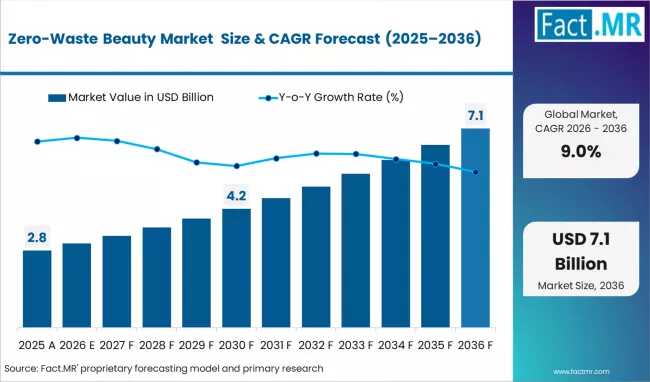
Zero-Waste Beauty Market Forecast 2026-2036: Market to Reach USD 7.1 Billion 2035 at 9.0 % CAGR
Zero-Waste Beauty Market
This growth, representing a steady CAGR of 9.0%, is being fueled by a rare convergence of corporate cost-cutting imperatives and high-end consumer expectations. Industry leaders are no longer just removing plastic; they are redesigning the entire ""beauty ritual"" to favor longevity over disposability.
Get Access Sample Report: https://www.factmr.com/connectus/sample?flag=S&rep_id=14590
The Shift from 'Green' Messaging to Refill Economics
While the first wave of sustainable beauty focused on recyclable materials, the 2026 outlook identifies Refillable Beauty Products as the primary growth engine, forecasted to command a 34.5% market share this year. The appeal is twofold: brands are significantly reducing packaging material costs, while consumers are being offered ""durable luxury""—heavyweight, premium glass or metal ""keepers"" paired with lightweight, lower-cost refill pods.
Key Market Drivers for 2026:
Policy Tailwinds: Europe’s Regulation (EU) 2025/40 is acting as a global catalyst, mandating stricter waste prevention and encouraging reuse models.
Retailer Intervention: Specialty beauty retailers, projected to hold a 31.2% distribution share, are increasingly gating shelf space for brands that can demonstrate a reduced packaging footprint.
Concentrated Formats: Waterless and concentrated formulations are gaining traction in the Skin Care segment (set for a 38.2% share in 2026), allowing for smaller shipping volumes and reduced carbon intensity.
Regional Insights: Europe and Asia Pacific Lead the Charge
Europe remains the regulatory epicenter of the zero-waste movement, but Asia Pacific is emerging as the fastest-growing region. Driven by a massive direct-to-consumer (DTC) ecosystem and a young, eco-conscious middle class, markets in China and India are bypassing legacy packaging formats in favor of innovative, ""package-light"" delivery systems.
Analyst Perspectives: The End of 'Sustainability as a Niche'
""The profit pool in zero-waste beauty has moved beyond simply using less plastic,"" says Shambhu Nath Jha, Principal Consultant at Fact.MR. ""Sustainable margin now sits in refill architectures and brand systems that reduce waste without making the beauty ritual feel like a compromise. The winners in 2026 are not the ones with the greenest messaging, but those who make refilling feel effortless and indulgent.""
Competitive Landscape: Systems over Products
Market dominance is shifting toward companies that view packaging as a long-term service rather than a single-use vessel. Key players are aggressively investing in ""closed-loop"" commercial designs where every purchase reinforces the next refill.
Leading entities shaping the 2026 horizon include:
L'Oréal Groupe, Unilever, The Estée Lauder Companies, Beiersdorf, Coty, L'Occitane Group, Albéa Group, Aptar Beauty, Quadpack, Lumson.
These organizations are increasingly moving toward mono-material architectures (such as PP-based systems) to simplify recycling and investing in airless pump technology to ensure product integrity during the refill process.
Strategic Outlook: The Road to 2036
The market is gravitating toward hybrid models. Brands are combining durable primary containers with lighter refill pods and e-commerce-ready packs. This shift ties sustainability to repeat-purchase behavior, turning a one-time environmental claim into a recurring commercial advantage. For institutional investors and brand executives, the mandate is clear: the refillable moment is the new loyalty program.
About the Research
The Zero-Waste Beauty Market Forecast 2026–2036 provides an exhaustive analysis of the global landscape, evaluating product types (Refillable, Solid/Waterless, Package-Free), distribution channels (DTC, Specialty Retail, E-commerce), and regional dynamics across North America, Europe, Asia Pacific, and beyond. The study utilizes a rigorous triangulation methodology, aligning packaging policy developments with first-party disclosures from the world's largest beauty conglomerates.
To View Related Report
Beauty Concierge Services Market https://www.factmr.com/report/beauty-concierge-services-market
Beauty Gummies Market https://www.factmr.com/report/beauty-gummies-market
Beauty Wearables Market https://www.factmr.com/report/beauty-wearables-market
Beauty Sheet Mask Market https://www.factmr.com/report/beauty-sheet-mask-market
Beauty Fridge Market https://www.factmr.com/report/beauty-fridge-market
Beauty Device Industry Analysis In The United States https://www.factmr.com/report/beauty-device-industry-analysis-in-the-united-states
Beauty Device Market https://www.factmr.com/report/beauty-device-market
Beauty Oils Market https://www.factmr.com/report/277/beauty-oils-market
S. N. Jha
Fact.MR
+ +1 628-251-1583
email us here
Legal Disclaimer:
EIN Presswire provides this news content "as is" without warranty of any kind. We do not accept any responsibility or liability for the accuracy, content, images, videos, licenses, completeness, legality, or reliability of the information contained in this article. If you have any complaints or copyright issues related to this article, kindly contact the author above.
