

Pretreatment System Market Forecast 2026–2036: Market to Reach USD 14.5 Billion at 6.4% CAGR
Pretreatment System Market
Pretreatment system market is segmented by Technology (Filtration Systems, Reverse Osmosis Systems, Ion Exchange Systems, Clarifiers and Separators, Others)
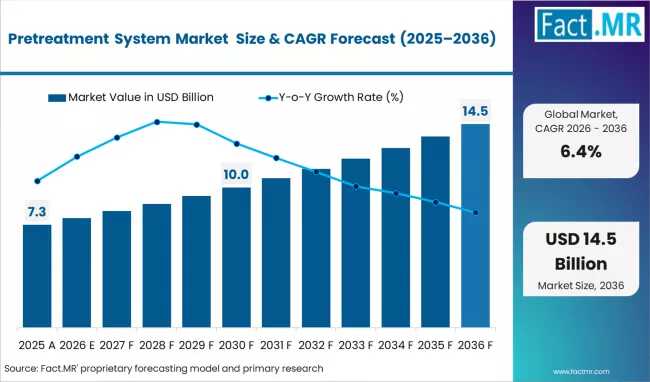
ROCKVILLE, MD, UNITED STATES, March 18, 2026 /EINPresswire.com/ -- In the world of heavy industry, the most expensive mistakes are often the ones that happen invisible to the naked eye. Contaminated feedwater entering a multi-million dollar boiler or a sensitive reverse osmosis (RO) membrane can cause damage that remains hidden for years, only to emerge as a catastrophic failure. This "silent" risk is driving a fundamental shift in how global enterprises manage their water.According to the latest strategic analysis from Fact.MR, the global Pretreatment System Market was valued at USD 7.3 billion in 2026 and is on a clear trajectory to reach USD 14.5 billion by 2036. Expanding at a compound annual growth rate (CAGR) of 6.4%, the market is evolving from a simple filtration niche into a critical pillar of industrial uptime and operational insurance.
Get Access Report Sample : https://www.factmr.com/connectus/sample?flag=S&rep_id=14582
The Economics of Prevention: Driving the 6.4% Surge
The economic logic of pretreatment is becoming impossible for C-suite executives to ignore: it is significantly cheaper to condition water before it enters a facility than to repair an asset once the damage is done. For years, capital-constrained facilities underinvested in upstream treatment, but a series of high-profile industrial interruptions has made the "real cost" of inadequate pretreatment visible.
Primary growth catalysts include:
Operational Reliability: As plants push for 24/7 uptime, any variation in feedwater quality becomes a production risk.
Compliance & Wastewater Control: Tightening municipal sewer protection requirements are forcing industrial players to treat effluent at the source.
Industrial Complexity: The rise of high-purity sectors like pharmaceuticals and semiconductors is mandating engineered pretreatment trains that go far beyond standard "off-the-shelf" solutions.
Dominant Technologies: The Rise of Reverse Osmosis (RO)
While the market utilizes a variety of methods—from ion exchange to clarifiers—Reverse Osmosis Systems are projected to lead the technology category with a 31.2% market share in 2026. RO has become the central purification step in high-demand applications, and the majority of current pretreatment investment is focusing on protecting these expensive membranes from fouling.
Process Water remains the leading application (29.4% share), largely because water quality directly impacts production yield and equipment life in the food, chemical, and pharmaceutical sectors. In these environments, water has transitioned from a utility afterthought to a critical production variable.
The Digital Frontier: Predictive Fouling and Real-Time Alerts
The most significant trend reshaping the landscape is the "digital layer." Leading suppliers are no longer just selling hardware; they are selling Water Program Ownership. This includes real-time feedwater monitoring, predictive fouling alerts, and automated chemical dosing adjustments.
"Pretreatment systems matter because downstream assets are expensive and unforgiving," notes Shambhu Nath Jha, Principal Consultant at Fact.MR. "The market is growing fastest where the cost of a water-related production interruption is obvious. Suppliers who win are those who can integrate hardware with digital diagnostics to prevent upsets before they happen."
Competitive Landscape: Ownership vs. Equipment
The market is currently seeing a divergence between pure equipment manufacturers and "program owners." Companies like Veolia, Ecolab Nalco Water, and SUEZ have built business models where the pretreatment system is merely the entry point into a decade-long service relationship. By controlling the data and the maintenance cycles, these players create high switching costs and institutional knowledge that pure-play hardware vendors cannot match.
Key industry participants shaping the global market include:
Veolia, Ecolab Nalco Water, SUEZ, Xylem, Evoqua Water Technologies, Kurita Water Industries, Pentair, DuPont Water Solutions, Pall Corporation, and Aquatech.
Regional Dynamics: Industrialization and Infrastructure
North America and Europe: Growth is driven by the modernization of aging municipal utilities and the strict environmental mandates surrounding wastewater pretreatment.
Asia Pacific: Rapid industrialization in India and China is creating massive demand for new-build process water systems, particularly in the chemicals and power generation sectors.
Middle East & Africa: Desalination pretreatment remains a primary focus as regions seek to stabilize their long-term water security.
Conclusion: The Future of Industrial Uptime
As the global industrial base moves toward more closed-loop water systems and intensive reuse, the role of pretreatment will only intensify. The leap from $7.3 billion to $14.5 billion represents a global acknowledgement that water quality is a strategic asset. For investors and decision-makers, the future lies in the integration of engineering judgment with real-time data—ensuring the pretreatment system remains the reliable guardian of the facility’s most expensive machinery.
Browse Full Report – https://www.factmr.com/report/pretreatment-system-market
To View Related Report:
Cryosystem Market https://www.factmr.com/report/2352/cryosystem-market
UHT Systems Market https://www.factmr.com/report/3395/uht-systems-market
HVAC Systems for Indoor Farms Market https://www.factmr.com/report/hvac-systems-for-indoor-farms-market
HVAC Systems Market https://www.factmr.com/report/hvac-systems-market
S. N. Jha
Fact.MR
+1 628-251-1583
email us here
Legal Disclaimer:
EIN Presswire provides this news content "as is" without warranty of any kind. We do not accept any responsibility or liability for the accuracy, content, images, videos, licenses, completeness, legality, or reliability of the information contained in this article. If you have any complaints or copyright issues related to this article, kindly contact the author above.
