

Wood Sanding Machine Market Outlook 2026–2036: Finish Quality Drives Steady Global Growth
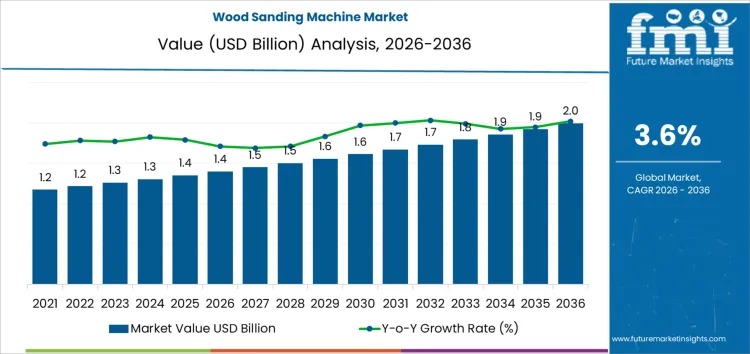
Wood Sanding Machine Market
The wood sanding machine market grows steadily as manufacturers invest in surface quality, automation, and rework reduction.
NEWARK, DE, UNITED STATES, January 30, 2026 /EINPresswire.com/ -- Global Market Overview
The Wood Sanding Machine Market is entering a phase of disciplined, quality-led growth. Valued at around USD 1.4 billion in 2026, the market is projected to reach USD 2.0 billion by 2036, expanding at a 3.6% CAGR. Unlike upstream woodworking equipment, sanding machines derive their commercial importance from surface consistency and downstream finishing efficiency, not from raw material removal rates.
In furniture, flooring, panels, and joinery, sanding determines coating yield, defect visibility, and rework intensity. As a result, sanding is increasingly treated as a quality control step embedded within production flow, rather than a standalone operation. Regions with strong furniture export bases and panel manufacturing clusters account for a disproportionate share of installed capacity due to strict, contract-driven surface appearance standards.
Request For Sample Report | Customize Report | Purchase Full Report –
https://www.futuremarketinsights.com/reports/sample/rep-gb-31286
Market Size and Growth Snapshot
Key indicators shaping the Wood Sanding Machine Market outlook include:
- Market Value (2026): USD 1.4 billion
- Forecast Value (2036): USD 2.0 billion
- CAGR (2026–2036): 3.6%
- Leading Machine Type: Belt sanders
- Leading End Use: Furniture manufacturing
- Key Regions: Asia Pacific, Europe, North America
Growth reflects incremental modernization rather than rapid capacity expansion, with value concentrated in automation, wider sanding formats, and improved dust management systems.
What Is Driving Demand Through 2036?
Demand for wood sanding machines is driven primarily by rework avoidance and finish consistency, not by headline productivity. Manufacturers upgrade sanding equipment to:
- Stabilize surface quality across batches
- Reduce manual finishing and labor dependency
- Compress cycle times between machining and coating
- Lower scrap rates and warranty risks
Once sanding formats and grit sequences are optimized for a product family, equipment replacement cycles lengthen due to training costs and process validation requirements. Buyers therefore focus on reliability, dust control, and changeover speed, rather than maximum throughput.
Machine Type Dynamics: Risk Control Over Speed
Machine selection in the Wood Sanding Machine Market reflects where surface defects are most costly:
- Belt Sanders: Account for roughly 40% of demand, especially in furniture and panel production. As the last step before coating or lamination, belt sanding errors directly translate into visible defects, rework, or scrap.
- Drum Sanders: Preferred where thickness calibration and flatness matter more than final surface aesthetics.
- Orbital Sanders: Common in semi-manual operations for localized correction and touch-up work.
- Disc Sanders: Used mainly for edge preparation and shaping, rather than surface uniformity.
The market structure reflects risk management, not a linear shift from basic to advanced tools.
Furniture Manufacturing Anchors Market Demand
Furniture manufacturing represents approximately 45% of global demand, as furniture economics are highly sensitive to surface appearance. Minor sanding defects acceptable in structural woodwork can make visible furniture components unsellable.
- Furniture producers operate under product-level aesthetic standards
- Sanding becomes a value-protection operation, not a preparatory step
- Investment prioritizes repeatability and defect reduction
Cabinet and interior fitting manufacturers follow, balancing appearance requirements with project timelines, while carpentry and construction applications remain more time-driven and less standardized.
Regional Growth Patterns
The Wood Sanding Machine Market shows varied growth dynamics across regions:
- India (4.2% CAGR): Driven by rapid modernization of organized furniture, modular kitchens, and panel manufacturing.
- China (4.0% CAGR): Supported by large-scale, export-oriented furniture clusters and engineered wood facilities.
- Brazil (3.5% CAGR): Growth shaped by line reconfiguration and surface quality upgrades rather than new plant construction.
- United States (3.2% CAGR): Demand tied to line upgrades, automation, and replacement driven by layout changes.
- United Kingdom (3.0% CAGR): Investment focused on finish consistency, dust control integration, and rework reduction.
Competitive Landscape and Supplier Positioning
Competition in the Wood Sanding Machine Market centers on performance reliability, ergonomics, and workflow integration. Leading players include:
- Bosch – balanced power, low vibration, and dust extraction compatibility
- DeWalt (Stanley Black & Decker) – robust construction for prolonged industrial use
- Makita – brushless motors and efficient dust management
- Festool – precision-focused systems with integrated workflows
- Grizzly Industrial – cost-effective, heavy-duty machines for high-throughput needs
Suppliers that combine consistent surface outcomes, accessory ecosystems, and service support maintain relevance where uptime and finish quality are critical.
Market Outlook: Rework Avoidance as the Core Driver
The Wood Sanding Machine Market grows when surface quality becomes a measurable business risk, not a cosmetic preference. As rework costs, rejects, and warranty claims gain visibility, sanding equipment shifts from optional tooling to process infrastructure.
Through 2036, market expansion will be shaped less by how much wood is cut, and more by how factories manage variation, protect finish quality, and control downstream risk.
Get data that aligns with your strategic priorities — ask for report customization today:
https://www.futuremarketinsights.com/customization-available/rep-gb-31286
Related Reports
Swarm Robotics Market – https://www.futuremarketinsights.com/reports/swarm-robotics-market
Copper Rotor Asynchronous Motors Market – https://www.futuremarketinsights.com/reports/copper-rotor-asynchronous-motors-market
Sound Attenuator Market – https://www.futuremarketinsights.com/reports/sound-attenuator-market
Have a specific Requirements and Need Assistant on Report Pricing or Limited Budget please contact us - sales@futuremarketinsights.com
About Future Market Insights (FMI)
Future Market Insights, Inc. (FMI) is an ESOMAR-certified, ISO 9001:2015 market research and consulting organization, trusted by Fortune 500 clients and global enterprises. With operations in the U.S., UK, India, and Dubai, FMI provides data-backed insights and strategic intelligence across 30+ industries and 1200 markets worldwide.
Contact Us:
Future Market Insights Inc.
Christiana Corporate, 200 Continental Drive,
Suite 401, Newark, Delaware - 19713, USA
T: +1-347-918-3531
Why FMI: https://www.futuremarketinsights.com/why-fmi
For Sales Enquiries: sales@futuremarketinsights.com
Website: https://www.futuremarketinsights.com
LinkedIn| Twitter| Blogs | YouTube
Sudip Saha
Future Market Insights Inc.
+1 347-918-3531
email us here
Legal Disclaimer:
EIN Presswire provides this news content "as is" without warranty of any kind. We do not accept any responsibility or liability for the accuracy, content, images, videos, licenses, completeness, legality, or reliability of the information contained in this article. If you have any complaints or copyright issues related to this article, kindly contact the author above.
