

Rethinking activated carbon for net-zero goals
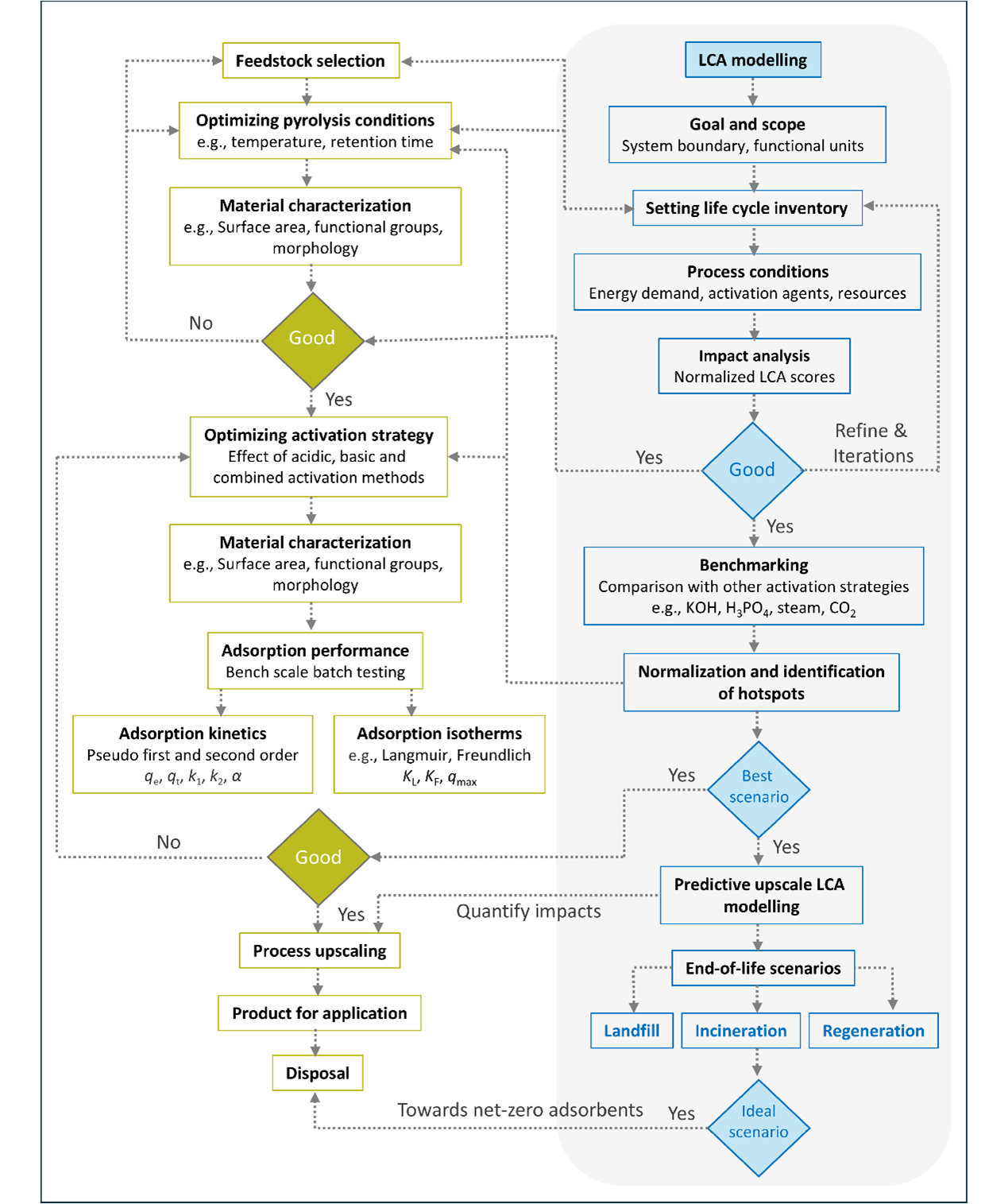
Multi-factor strategic decision diagram for the selection of adsorbents based on material optimization, performance, and life cycle considerations.
GA, UNITED STATES, December 25, 2025 /EINPresswire.com/ -- Adsorbents play a critical role in water treatment, yet their production often involves high energy use and carbon emissions. This study proposes a multi-factor framework to identify adsorbents that simultaneously achieve high contaminant removal efficiency and low environmental impact. By integrating adsorption performance with life cycle assessment and end-of-life analysis, the research evaluates bio-based activated carbons produced under different activation strategies. The results reveal that a dual-activated pine-bark-derived adsorbent delivers superior adsorption capacity while minimizing greenhouse gas emissions when assessed on a functional performance basis. The framework demonstrates how combining material efficiency with environmental metrics can guide the selection of next-generation adsorbents aligned with net-zero objectives.
Activated carbon is widely used to remove organic pollutants from water, but conventional coal-derived materials carry a significant environmental burden due to fossil-based feedstocks and energy-intensive processing. Bio-based alternatives derived from agricultural residues offer a promising route toward more sustainable adsorbents, yet their environmental performance is rarely assessed alongside adsorption efficiency. Most evaluations rely on mass-based life cycle metrics, which may overlook how effectively a material removes contaminants in real applications. Moreover, end-of-life scenarios such as regeneration or disposal are often excluded from sustainability assessments. Based on these challenges, there is a clear need to develop an integrated approach that systematically evaluates adsorbent performance, life cycle impacts, and end-of-life outcomes.
Researchers from Kyung Hee University reported on August 23, 2025, in Frontiers of Environmental Science & Engineering a comprehensive strategy for selecting net-zero-oriented adsorbents for water treatment. The study introduces a multi-factor decision framework that combines experimental adsorption testing with life cycle assessment and end-of-life analysis. Using pine bark as a renewable precursor, the team compared multiple chemical activation routes and identified an optimal adsorbent that balances high pollutant removal efficiency with reduced greenhouse gas emissions, offering practical insights for sustainable water treatment materials.
The researchers synthesized pine-bark-derived activated carbons using five different activation strategies, including single and dual chemical treatments. Among these, dual activation with sodium hydroxide followed by hydrochloric acid produced an adsorbent with the most favorable combination of surface structure and functional groups. This material exhibited a maximum humic acid adsorption capacity of 15.84 mg per gram, substantially outperforming both singly activated biochars and commercially available activated carbons.
To evaluate sustainability, the study applied life cycle assessment using both mass-based and adsorption-capacity-based functional units. While mass-based comparisons showed similar carbon footprints across several activation methods, performance-based assessment revealed a clear advantage for the dual-activated adsorbent. Because less material was required to remove the same amount of contaminant, its greenhouse gas emissions and cumulative energy demand per unit of pollutant removed were the lowest among all candidates.
The analysis further identified electricity use during drying and pyrolysis as major environmental hotspots. Importantly, a prospective scale-up model demonstrated that industrial-scale production could reduce carbon emissions per kilogram of adsorbent by nearly 90% compared with laboratory-scale synthesis. End-of-life analysis showed that regenerating spent adsorbents offers substantial emission savings relative to landfilling or incineration, reinforcing the value of circular material strategies.
According to the authors, evaluating adsorbents solely on adsorption capacity or production emissions provides an incomplete picture of sustainability. They emphasize that performance-based life cycle metrics better reflect real-world environmental benefits, especially for materials designed to remove pollutants efficiently. The study highlights how combining experimental data with life cycle modeling can uncover trade-offs that are invisible when using single-criterion assessments. This integrated perspective, the researchers note, is essential for guiding material design choices that genuinely contribute to carbon neutrality in environmental technologies.
The proposed multi-factor selection framework offers a practical tool for researchers, engineers, and policymakers seeking sustainable water treatment solutions. By aligning adsorption efficiency with life cycle performance and end-of-life considerations, the approach supports informed decision-making for low-carbon material deployment. The findings suggest that bio-based activated carbons, when optimally designed and regenerated after use, can significantly reduce the environmental footprint of water purification systems. Beyond adsorbents, the framework can be extended to other functional materials where performance and sustainability must be jointly optimized, contributing to broader net-zero and circular economy goals.
References
DOI
10.1007/s11783-025-2068-6
Original Source URL
https://doi.org/10.1007/s11783-025-2068-6
Funding information
This study was supported by a National Research Foundation of Korea (NRF) grant funded by the Korean government (Ministry of Science, ICT & Future Planning) (No. RS-2024-00350751).
Lucy Wang
BioDesign Research
email us here
Legal Disclaimer:
EIN Presswire provides this news content "as is" without warranty of any kind. We do not accept any responsibility or liability for the accuracy, content, images, videos, licenses, completeness, legality, or reliability of the information contained in this article. If you have any complaints or copyright issues related to this article, kindly contact the author above.
